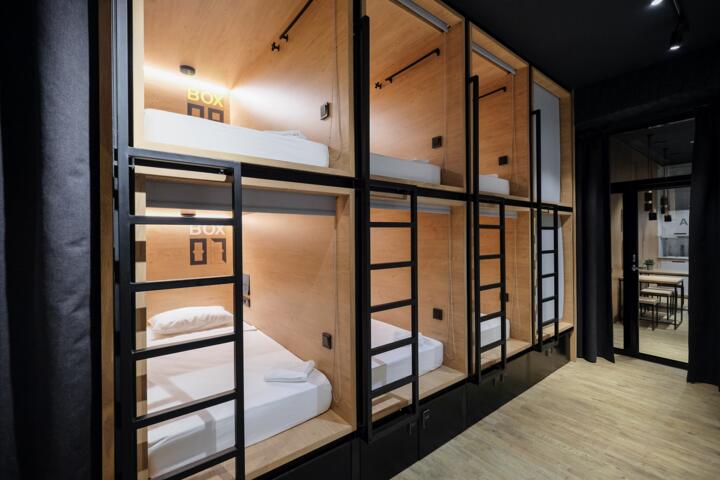
There’s a peculiar moment that happens the first time you step inside a capsule hotel. Your brain, conditioned by decades of conventional hotel rooms with oversized armchairs and decorative pillows nobody has ever voluntarily used, begins searching for familiar landmarks. A closet. A desk. Maybe a suspiciously expensive minibar.
Instead, you find what looks like the love child of a Scandinavian sleeping pod, a first-class airline suite, and a set piece from a science-fiction movie that predicted the future with unnerving accuracy.
Welcome to the capsule hotel.
For some travelers, capsule hotels are brilliant. They strip accommodation down to its essentials: a secure place to sleep, shower, recharge devices, and continue exploring. For others, they can feel like voluntarily spending the night inside a high-end filing cabinet.
The difference between those two experiences often comes down to knowing exactly what you're booking before you arrive.
Capsule Hotels Are Different
The phrase "capsule hotel" has become travel's equivalent of the word "craft." It sounds straightforward until you realize it can mean wildly different things.
Some properties offer futuristic pods with climate controls, ambient lighting, soundproof walls, smart locks, and enough privacy to make you forget you're sharing a building with hundreds of strangers. Others provide little more than a mattress tucked into a cubbyhole separated from neighboring guests by a thin curtain that performs all the acoustic insulation of a paper napkin.
Photos can be deceptive. Wide-angle lenses have convinced countless travelers that they were booking a sleek space-age retreat when they were actually reserving what amounts to a particularly ambitious bunk bed.
Before booking, pay close attention to dimensions, privacy features, ventilation systems, and whether the pod has a door, sliding screen, or merely a curtain. Those details matter far more than how dramatic the marketing photos look.
The Privacy Trade-Off
Let's address the elephant in the pod.
Capsule hotels are designed around efficiency, not isolation.
Even the most luxurious properties operate within a shared environment. Bathrooms are usually communal. Lounges are communal. Hallways are communal. Sometimes even the act of finding your socks at 6:30 a.m. becomes a surprisingly public performance.
If you're the type of traveler who requires complete silence, spreads belongings across every available surface, or conducts lengthy video calls while pacing the room, a capsule hotel may test your patience.
On the other hand, if your hotel room typically serves as little more than a charging station between adventures, the reduced footprint can feel remarkably liberating.
Think of it less as renting a room and more as renting an exceptionally well-designed sleeping headquarters.
Noise Is the Great Variable
Every capsule hotel promises tranquility.
Reality occasionally has other plans.
The greatest threat to your sleep isn't usually traffic outside. It's Kevin from somewhere three pods down discovering at 2:17 a.m. that his backpack apparently contains every object manufactured since 1984.
Zippers. Plastic bags. Velcro. Phone alarms. Snoring that deserves its own geological classification.
These are the true soundtrack of shared accommodations.
Many high-end capsule properties actively combat this problem with soundproofing, quiet floors, and strict behavioral policies. Others simply hand you complimentary earplugs and wish you good luck.
Read guest reviews carefully. Travelers are often brutally honest about noise levels, and their experiences will tell you far more than promotional copy ever will.
Location Over Amenities
A surprising number of first-time capsule hotel guests obsess over pod specifications while overlooking the factor that will shape their trip most dramatically: location.
A compact sleeping space located in the heart of Tokyo, Singapore, Seoul, London, or Amsterdam can provide far more value than a larger room requiring an hour-long commute each day.
Capsule hotels emerged partly because urban real estate is expensive. The concept works best when those space savings translate into unbeatable access to transportation hubs, nightlife districts, business centers, or major attractions.
In many cases, you're not paying for square footage. You're paying for geography.
Luggage Can Be a Challenge
Many capsule newcomers imagine sliding into their pod with a full-size suitcase beside them.
Reality quickly intervenes.
Most capsules are engineered for humans, not humans plus three weeks' worth of vacation shopping.
Large bags are often stored in separate lockers or designated luggage rooms. Some properties provide generous storage solutions. Others offer compartments that seem specifically designed for travelers carrying exactly one backpack and no ambitions.
If you're traveling with oversized luggage, sports equipment, or enough souvenirs to open a small gift shop, verify storage policies before arrival.
Your future self will thank you.
Check the Gender Policy
This is one detail travelers frequently overlook.
Some capsule hotels are mixed-gender. Others maintain separate floors. Some are women-only. A few cater primarily to business travelers of a specific demographic.
These policies vary significantly by country, culture, and property.
Never assume that one capsule hotel's setup reflects another's. Read the accommodation details thoroughly to avoid surprises at check-in.
Capsule Hotels Feel Luxurious
There's a persistent myth that capsule hotels are merely budget accommodations for travelers who have exhausted every other option.
That stereotype expired years ago.
Today's premium capsule hotels often feature designer interiors, spa facilities, coworking lounges, wellness programs, high-end bedding, smart technology, and concierge services that rival traditional hotels charging several times more.
The capsule itself may be small, but the overall experience can be remarkably sophisticated.
Much like first-class airline suites, the magic lies in thoughtful design rather than raw square footage.
Claustrophobia Is Real
This may sound obvious, but it deserves mention.
If elevators make you uneasy, if windowless rooms feel oppressive, or if confined spaces trigger anxiety, a capsule hotel deserves serious consideration before booking.
Modern pods are generally well-ventilated and carefully designed to avoid feeling cramped, but they remain enclosed sleeping environments.
For many travelers, the experience feels cozy and cocoon-like.
For others, it feels like trying to sleep inside a premium-grade bread toaster.
Know which category you fall into.
Final Thoughts
Capsule hotels aren't trying to replace traditional hotels any more than espresso bars are trying to replace living rooms.
They're solving a different problem.
When done well, they deliver precisely what modern urban travelers need: comfort, efficiency, security, and location without forcing guests to pay for space they'll barely use.
The smartest travelers approach capsule hotels with the right expectations. They don't arrive expecting a sprawling luxury suite. They arrive expecting a thoughtfully engineered base camp in the middle of a city waiting to be explored.
And when viewed through that lens, the humble capsule begins to look less like a compromise and more like one of travel's cleverest innovations.