Philosophy of Motion
The "One Bag" movement is rooted in the Pareto Principle: we typically wear 20% of our clothes 80% of the time. When you audit a standard 50lb checked suitcase after a trip, you will likely find three pairs of shoes never worn and outfits "packed for a specific occasion" that never arose. Expert travel is about optimizing that 20% to perform multiple roles.
In practice, this means moving away from cotton—which is heavy and slow to dry—and toward technical fabrics like Merino wool or synthetic blends. For instance, a traveler using a 35L-45L pack can save an average of 45 minutes per flight by skipping the luggage carousel. Statistically, SITA’s 2023 Baggage IT Insights reported that while mishandled bag rates have improved, the global cost of lost luggage still reaches billions annually. Avoiding the hold isn't just about weight; it’s about risk management.
Consider the "Personal Item Only" challenge. I once navigated a 10-day business trip through London and Paris using only a 28L Aer City Pack Pro. By utilizing a modular system—where every item of clothing matched every other item—I maintained a professional appearance while being able to walk three miles to my hotel when the taxi strike occurred. That is the freedom of light packing.
The Cost of Overpacking
The most common mistake is the "What If" syndrome. Travelers pack for hypothetical scenarios—a sudden gala, a monsoon, a mountain hike—despite their itinerary being 90% urban. This leads to "decision fatigue" every morning of the trip and physical exhaustion from hauling dead weight across cobblestone streets in Rome or through the Tokyo subway.
Overpacking also carries a significant financial penalty. Major carriers like United Airlines or Lufthansa often charge between $35 and $75 for a first checked bag on domestic or short-haul routes. On a multi-city trip, these fees can easily exceed $300. Furthermore, heavy bags are the primary cause of gate-check anxiety, where travelers are forced to hand over their valuables because their bag exceeds the strict 7kg to 10kg limits imposed by budget carriers like Ryanair or AirAsia.
Real-world consequences include missed connections. If you have a 45-minute layover in Frankfurt, having to wait for a checked bag to transfer—or worse, having to re-check it after customs—virtually guarantees you won't make your next flight. Luggage becomes a tether, limiting your flexibility to take an earlier train or change plans on the fly.
Packing Solutions
1. Adopt the 5-4-3-2-1 Rule with a Technical Twist
The 5-4-3-2-1 rule is a classic framework: 5 sets of socks and underwear, 4 tops, 3 bottoms, 2 pairs of shoes, and 1 accessory. To make this work for 14+ days, you must switch to Merino Wool. Brands like Unbound Merino or Icebreaker create shirts that are naturally antimicrobial. You can wear a Merino tee for three days without it retaining odors, effectively tripling your wardrobe capacity without adding bulk.
2. Utilize Compression Over Folding
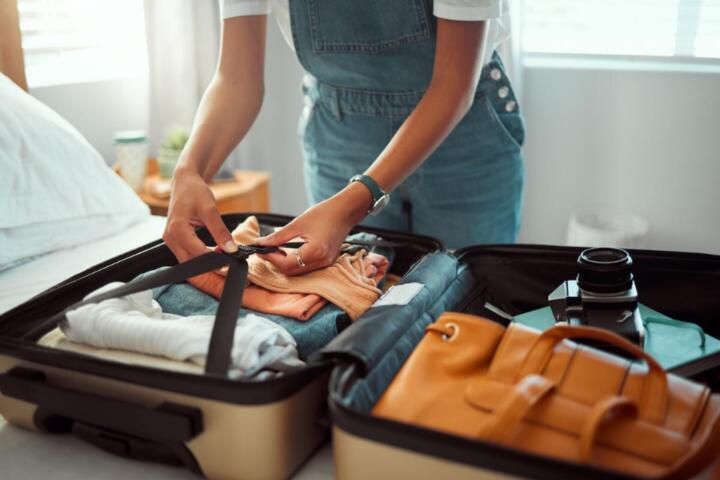
Folding clothes is the least efficient use of space. Use Peak Design Packing Cubes or Eagle Creek Specter Tech sets. These aren't just bags; the compression zippers remove excess air, reducing the volume of your clothing by up to 30%. In practice, this allows you to fit a puffer jacket and four days of clothes into a space the size of a shoebox.
3. The "Heavy on the Plane" Protocol
Your heaviest items should never be inside the bag during weigh-ins. Wear your boots, your heaviest coat, and your bulky denim on the plane. Use your jacket pockets as "secret storage" for heavy electronics, power banks, and chargers. This can easily shave 2kg off your bag's official weight, keeping you under the 7kg limit of strict airlines.
Efficiency in Action
Case Study 1: The Multi-Climate Business Sprint
Company/Individual: A tech consultant traveling from humid Singapore to chilly London for investor meetings.
The Solution: They utilized a 35L Minaal Carry-on 3.0. They wore a blazer made of technical "commuter" fabric and layered a thin Merino sweater underneath. Instead of a heavy overcoat, they used a Uniqlo Ultra Light Down vest as a mid-layer.
The Result: Total bag weight: 6.8kg. They avoided a $60 gate-check fee and transitioned from heat to cold without needing a separate suitcase.
Case Study 2: The 30-Day Nomad Experiment
Individual: A freelance photographer traveling through Japan for one month.
The Solution: Adoption of the "Sink Wash" method using Sea to Summit Pocket Laundry Wash. By packing only 4 days of clothes and washing them every 3rd night, they reclaimed 60% of their bag space for lenses and a tripod.
The Result: They traveled through 12 cities using only the Peak Design 45L Travel Backpack. They saved an estimated 12 hours total by not waiting for luggage.
Carry-On Pro Guide
| Category | Must-Have Items | Pro Hack |
|---|---|---|
| Clothing | Merino Tees, 2x Pants | Roll & Compress |
| Footwear | 1x Sneakers, 1x Boots | Stuff with socks |
| Toiletries | Shampoo bars, FlatPaks | Switch to solids |
| Tech | GaN Charger, Power bank | Use tech pouch |
Common Pitfalls
The biggest pitfall is bringing "just in case" shoes. Shoes are the densest, most awkwardly shaped items in your kit. Limit yourself to two pairs: one on your feet, one in the bag. If you can't hike, walk, and go to dinner in those two pairs, your shoe selection is the problem, not your bag size.
Another error is choosing a "heavy" empty bag. Many premium leather or heavy canvas bags weigh 2kg to 3kg before you put a single sock inside. If your airline limit is 7kg, you've already lost nearly 50% of your allowance to the container itself. Look for high-tenacity nylon which offers durability at a fraction of the weight.
FAQ
How do I handle laundry on a long trip?
The most effective method is the "Shower Wash." Take your synthetic or Merino items into the shower, use a bit of soap, wring them in a dry towel to remove excess moisture, and hang them up. They will be dry by morning.
What if the airline forces me to gate-check my bag?
Always have a "Go-Bag" strategy. Keep your essentials (passport, medication, power bank) in a small tech pouch or your personal item. If the overhead bins are full, you can hand over the main bag without losing your vital gear.
Can I bring a suit in a carry-on?
Yes. Use the "Inside-Out Fold" method. Turn the jacket inside out, tuck the shoulders into each other, and lay it flat at the top of your packing cube. Alternatively, use a specialized garment sleeve.
How do I fit bulky winter gear?
Layering is key. Instead of one massive parka, use a thermal base layer, a Merino sweater, and a windproof shell. If you must bring a heavy coat, wear it onto the plane; once on board, you can stow it in the overhead or use it as a pillow.
Is a 40L bag too big for budget airlines?
It depends on the dimensions. A 40L bag that is tall and thin might pass, while a wide one won't. Always check the specific dimensions for airlines like EasyJet or JetBlue, as they vary by 2-5 centimeters.
Author’s Insight
After five years of digital nomadism across 40 countries, I have learned that your bag's weight is directly proportional to your stress levels. I once spent a month in Japan with a 20L bag, and it was the most liberating experience of my life. My top advice is to buy a luggage scale and weigh your bag at home; if it's over 8kg, take something out. You will never regret the things you didn't bring, but you will always regret the extra weight on a long terminal transfer.
Summary
Mastering the carry-on-only trip is a skill set that pays dividends in time, money, and physical health. By investing in high-quality technical fabrics, utilizing compression tools like those from Eagle Creek, and adhering to a strict modular wardrobe, you transform travel from a logistical chore into a streamlined experience. Start by auditing your next three-day trip as if it were a two-week journey. Focus on "multipurpose" rather than "multi-item." The goal isn't just to pack less; it's to travel better. Ditch the heavy suitcase, bypass the baggage claim, and step out of the airport while others are still waiting at the carousel.